I recently came across a poster of the film JNU – Jahangir National University – a right wing spoof on the Jawaharlal Nehru University in New Delhi. I was surprised to see Piyush Mishra in the cast list and even more surprised to see his interview with Lallantop where he says that “communism” destroyed 20 years of his life. Strangely, my first reaction was not anger. He says in the interview that it was Delhi which introduced him to communism and took him away from his family, made him a bad son and a bad husband.
Now he has vowed to become a “good father” by leaving behind communism and turning to right wing politics. He now respects “Modi Sahab” and has pledged his vote for him. Cute, isn’t it? Not the first actor and person to somersault between ideologies to make money. And as he says, what’s wrong in making money? It was his communism which taught him that making money is bad.
This black to white transition of Mishraji puzzled me with a couple of questions. Someone who says that they “understand” and have dedicated 20 years of their life to communism, why would such a person switch over to right wing politics and praise a hate-monger?
Mind you, I am not the one to oppose any criticism of the left. A student of JNU myself, I have seen so-called “left” activists speak of equal distribution of wealth while also owning luxury brands purses and watches. And I have also seen them go a complete 180 degrees on women’s issues and safety. I have also seen them fight for rights and their sheer resilience to save education institutions from autonomy. Ideologies are full of contradictions like the people who make them.
Coming back to Mishraji, I wonder why wouldn’t he question the “left” he was part of? Did he never read Phule, Ambedkar or Kanshiram that it was so easy for him to start mimicking the right? Or was it his caste privilege which made it easy for him to simply switch ladders? For someone who wrote songs like husna and ghar, did it not hurt his conscience to plagiarise Habib Jalib in support of an authoritarian rule? Mishraji, you prove the point of the politics you are now supporting – if you ask questions, you will have no money. If you comply, you will be celebrated!
It has been almost three months since I arrived in the UK. The first theatre production I watched was the underwhelming Macbeth by the Royal Shakespeare Company at Stratford-Upon-Avon – Shakespeare’s birthplace, now capitalised by tourism, of course. To wash off the sour taste of RSC from my mouth, I had decided to watch a more experimental play – the place where I feel the most at home within the theatre circuit. (While writing this, I wonder if they have the same distinctions of commercial and experimental in the UK as there is in India…)
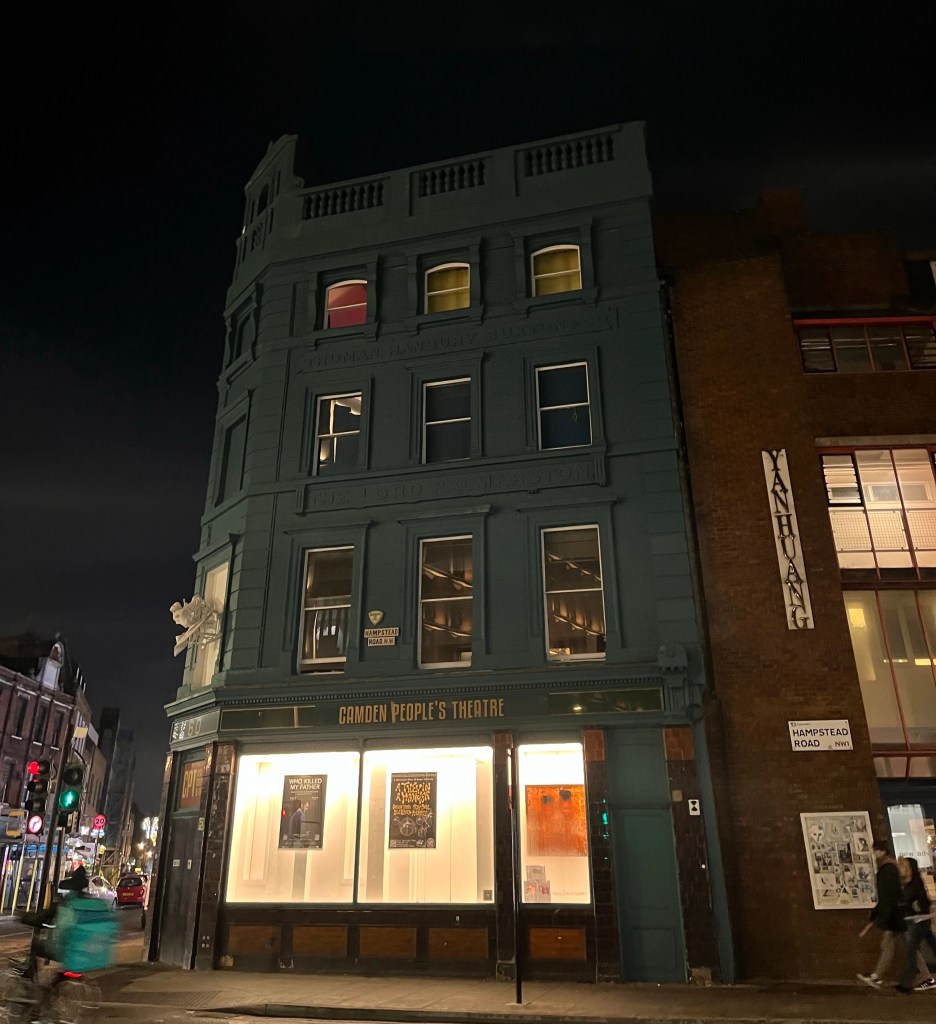
Walking through the busy pool of people, Christmas laden and Saturday marketed streets of London and at the same time grasping the first worldliness of the city, I kept discovering many canonical as well as not-so-known theatre and art spaces in the nooks and corners of the city. I walked for 50 minutes from Covent Garden to get to the quaint little Camden People’s Theatre – having no idea of what to expect within the building!
Camden People’s Theatre
Established in 1994, the Camden People’s Theatre is known for its Sprint Festival celebrating ‘new and adventurous theatre’. One walks into a lobby area with a counter selling tickets and mulled wine with some snacks. There is a lounge area where people were chatting up. On the left was the theatre space – a basement with a seating capacity of approximately 50 people. I heard of the play through my colleague, Nora, who is also one of the founders of the Surrogate productions established in 2019 in Edinburgh.
A still from ‘Who Killed My Father’ featuring Michael Marcus
What intrigued me about the play was its title – “who killed my father” was a statement and not a question. Based on Édouard Louis’ book with the same name and translated by Lorin Stein, the play was an interwoven tapestry of politics, masculinity, queer identity, social constructs and behaviours of everyday life. A monologue-dialogue of a gay ‘son’ with his alcoholic, right-wing, and hyper masculine father who works as a factory worker, the play peeled layers of masculinity imposed onto the public by social and political super structures.
Beginning with Édouard reflecting on his relationship with his now ailing and old father, the play rapidly accelerated into questions of social justice. The actor, Michael Marcus, painted a nonchalant Édouard, traversing the audience through mimicked versions of his mother, father, grandmother and brother. Maintaining eye contact with audience members throughout the play, the play roped in its spectators to ask the same questions that Édouard begs answers for – who decides what masculinity or femininity is, why is there a dichotomy, how to ‘be’, and finally how does the state function invisibly into the lives of its citizens. Channeling his anger and hatred towards his father who is unable accept his son’s queer identity, the writer swiftly brings us into compassionate questioning of the social brutality that his poor father had to endure.
Critiquing the neo-liberal reforms in the recent past of France, Édouard declares that what we need today is Revolution. Wearing the neon worker’s vest and standing on top of a construction brick, Édouard blames the politicians of France – naming them with photographs – for his father’s ailments at the age of 50 and subsequent death. The neon vest rightly sums up the precarious situations in which a worker has to labour his body – the work being essential for ‘development’ and yet putting the worker’s body in danger. And yet, it is the same body(ies) on which various reforms are played out which rhizomatically breed masculinities and anger. To ‘man-up’ is then intricately tied to the phallus of the State and the nationalism it espouses.
An important text of our times and even though it is a rewriting of recent social and political history of France, the play resonated with the audience in United Kingdom, it resonated with me as an Indian. The images of politicians seemed easily replaceable with leaders of various countries today headed towards fascism and an authoritarian regime.
As gripping as the text was, the directorial choices by Nora Wardell were a collage of working with several props – sometimes a little too much. For instance, the ship submerged in a fish tank seemed unnecessary but the white powder from the car crash of his father’s car affectively charged the space. Nevertheless, the patchwork of scenes and jumping of timelines work in a seamless manner with the interweaving of music and lights. Michael Marcus gave a powerful performance holding onto the nonchalance at the same time diving deep into emotionally scarring incidents of the writer’s childhood.
The play produced by Surrogate Productions has toured in Scotland and also ran at the Edinburgh Fringe Festival.
Watching a performance crafted by senior art workers and artists already puts the audience in a fairly responsible position – to understand or at least imply to understand the experience being served! Before the performance of Mallpractice & The Show began today, my mind was already clouded with these thoughts thinking about Atul Pethe’s earlier works that I have witnessed online or offline. Clearing them all, I promised myself to look at the performance for what it is without taking the responsible burden of analysing the stalwart director’s vision behind making it.
A few minutes in the performance, I realised I was in for a ‘physico- sonic’ experience. The performance has barely any dialogue. Before calling the performance a ‘play’, let me first stress on the different meanings of ‘play’ out of the bounds of theatre and performance. The word ‘play’ is derived from Old English ‘plegian’ (to exercise) and developed further in Middle Dutch as ‘pleien’ (leap of joy, dance) leading us to one of its rudimentary meanings – a recreational activity (the word recreation denoting means of refreshment or diversion). To these layered meanings add another layer of the Marathi word ‘खेळ’. One could then think of ‘play’ as a recreational activity taking place between one or many beings at a time focused on refreshing or creating a diversion from the set ways of things through experience. Here, one needs to complicate ‘recreation’ from its generic ‘entertainment’ interpretation to understand its relation to the politics of everyday life.
Mallpractice & The Show gave an experience of such a play. While the puritans, formalists, and positivists would stress on the ‘play’ to have a linear narrative, a story line, a beginning, middle and end, Mallpractice & The Show play-ed with conventions to find different nexuses between the female body, sound, light, colours, textures, materiality and politics of a patriarchal society. As the solo performer of the play, when Rujuta Soman (who is an international Kathak dancer herself) enters the circular stage, one is compelled to pin her body to a certain character. The ghungroo on her trolley bag, her attire, gait, and eventually her taps give way to a dancer’s character. Nonetheless, the unfolding of events lays out a far more universal and by that logic, a patriarchal issue – the patriarchal gaze.
Having passed through a bustling city and vibing to its various rhythms, when the bubbly, cheerful dancer reaches her rehearsal space she quickly takes off her clothes to stretch in her undies and bra for the dance performance. After a piece of soulful Kathak dancing and phone ringtone having interrupted her practice, she gets to know that someone has leaked her photos while she was stretching. The projections on the floor and the black backdrop show her from angles from which the audience is seated – on three sides of the square staging area. Thus, the audiences’ view of the actress gets translated into various camera angles that captures the dancer stretching. Once the projections enter the stage for a good 5-10 minutes wherein the dancer attempts to deal with her modesty being compromised and circulated widely on the web with lewd comments, the audience is forced to reassess and question their gaze. For me, this was the take away from the performance! The actress, director, musicians, and light designers play-ed with the audiences’ vision as well as compelled them to question their gaze creating a diversion from the patriarchal politics of everyday life.
After having slut-shamed and cat-called, the character falls into depression characterised eerily with the mobile phone torch on her face, the actresses’ own hand capturing her face, and a looming black cloth which keeps jumping the lines of materiality, at times assuming to be a claustrophobic black drape and some times posing as a long dark shadow in the play of lights. It is through this darkness that the character finds her own light mocking the bubbles that people and the patriarchal society live in. This is symbolised quite literally by a bubble wrap. Here again, the character teases the audiences’ gaze by initially opening half of her kurta and then resorting to wearing only her inner wears. Dancing freely in the bubble wrap, she bursts many bubbles (literally and metaphorically) eventually separating herself from the wrap and dancing her way out of the box she has worn on her head. She finally comes back to her dance, picks up her abandoned ghungroos – the only thing that keeps her going!
While the play conceptually achieved an affective transference, the flow of the play and the performance was jerky and seemed disjointed. Can one think of this as an act of Brechtian alienation? This in no way preaches for a linear or formalist narrative, but opens up questions about post-dramatic theatre and performance and the ongoing experiments in this domain. Can we think of post-dramatic theatre vis-a-vis the idea of ‘play’?
Is theatre relevant in the age of mass media and communication? What is the need for theatre arts in a society addicted (almost, to give the benefit of the doubt) to scrolling on screens? Is theatre just a form of ‘entertainment’? In times, when we hear the rumours of theatre dying, who and what keeps it alive? What is the responsibility of the State in safeguarding the interests of the theatre community? Moreover, should theatre depend on government funding for its development, given the agendas of changing governments and expected narratives from the makers? With patronage to arts in India changing several hands in the last two hundred years or so, how can theatre pave its way in a predominantly capitalist society?
Digital Poster of the Production. (Courtesy: Natak Company)
Pune-based Natak Company’s latest production in collaboration with Goethe Institute and Swiss Consulate – अडलंय का? portrays theatre as it is – unapologetic and full of life. The name of the play loosely translates from Marathi to English as ‘is it stopping you?’. A Marathi translation by Shounak Chandorkar of Charles Lewinsky’s German play ‘Die Besetzung’ (The Occupation) and directed by Nipun Dharmadhikari, the play situates theatre as a form and as a practice in its contemporary times interrogating its relevance in a world overpowered by wealth and capitalism as its god. Thorough realities of the world and fantasies of theatre are pitted against one another through the characters of Ms. Folmer, an employee in a business consultancy and Joachim Albrecht, a seasoned theatre actor. While the two characters debate on the issue of budget allocation to the theatre by the government and a possible twenty per cent cut to navigate the current economic crisis, the anxieties of Albrecht and his embodiment by Atul Pethe echoes the misery of artists in the Covid Pandemic and its current aftermath. A production that talks about budget allocation to theatre eerily underlines the absence of such a budget to the theatre in India and the country’s lack of a solid cultural policy since independence. It raises questions on the changing nature of patronage to arts and how theatre has walked a tightrope balancing between its urges to be contemporaneous in a public domain and at the same time attempting to make a living. The sounds of creaking fans that intercepted the performance at Bharat Natya Mandir, where the production was staged was living proof of the decaying state of affairs for theatre infrastructure in India today.
A scene from अडलंय का? (Bharat Natya Mandir, February 11, 2022)
Ms Folmer, played by Parna Pethe builds the side of capitalism in its interaction with the theatre and stresses the importance of ‘customer is god’ which underscores her visit to Albrecht in a theatre space. In the quest to save the theatre, Albrecht engages Folmer into a game whose scores are displayed on a LED screen at the centre stage. The play begins with Atul Pethe speaking in a husky voice trying to entangle Folmer in a business deal which eventually fizzles out making way for the rest of the play. Being a lengthy scene and dialogues getting lost in the husky voice, it takes some time for the audience to get into the middle of the action. Both Folmer and Albrecht keep using thrilling tactics to convince each other as well as the audience about their ways of life and choices. Nipun Dharmadhikari, in his directorial role, attempts to break the fourth wall and brings Parna Pethe into the audience seating to soak into the wonders of theatre and storytelling that Joachim excitedly displays. Projections of computer windows, city lights and landscapes falling onto the bodies of the characters embodied by the father-daughter duo gives an impressionable takeaway moment from the play as it enables a complex account of the interaction between arts, technology, capitalism and corporate worlds. The set which consists of various theatre props, background curtains and objects, at one glance seem like a properly arranged mess, but with the play progressing become alive just as Albrecht quite romantically proclaims – ‘सगळ्या वस्तू जिवंत आहेत…त्यांच्या विषयी ममत्व दाखवा’ (all objects are alive. Show some motherhood towards them). The world of fantasy and ‘fakeness’ usually associated with theatre becomes one of the central points of debate against the very ‘real’ economic crisis and struggles of corporate life. At a point Folmer irritably questions Albrecht,
“उगाज असं नाटक कशाला जगवत ठेवायचे?” (Why to keep drama alive?)
Albrecht: कडधान्य आणि कडबा मधलं अंतर कळावं म्हणून नाटक हवे. (Drama is needed to understand the distance between cereal and fodder.), thus underlining the importance of theatre for a society.
Parna’s embodiment of Folmer is noteworthy as she eventually gets bitten by the ‘theatre bug’ and for one reason or another keeps getting back to Joachim with different plans. Atul Pethe colours the character of Albrecht with a variety of shades displaying his calibre as an experienced theatre worker. The lines of Albrecht get a deeper meaning when Atul Pethe says, ‘थिएटर्स म्हणजे शहराचे ओक्सिजन प्लांट्स आहेत’ (Theatres are oxygen plants of a city), or ‘नाटक जिवंतपणाचं लक्षण आहे’ (drama is a symbol of liveliness). The execution of the play is smooth and deserving applause from the team are the backstage, light design (Sachin Lele and Vikrant Thakkar), set design (Pradeep Mulye) and make-up (Ashish Hemant Deshpande) which help traverse the world of translation and synchronising of different cultures and races. The play ends with Folmer saying ‘I resign, Sheer fantasy’ turning the tables around and letting the audience take home the debate between the two characters. What remains worth mulling over is what gets lost in translation – the journey from ‘Die Besetzung’ (the occupation) to अडलंय का? (Is it stopping you?).
How does one person’s truth become the others? Are truths based on hiding each others lies to hide from persecution? Is one persons truth, another’s lie or another’s lie ones truth? And then we talk about history and being on the right side of it. Or the left, or the centre or the liberal. The famous words of Walter Benjamin ring in our ears, ‘History is always written by the victor and histories of the vanquished belong to a shrinking circle of those who were there’. The blood flown and bodies burned are forgotten and the shoes in the museum or baggages of the dead displayed as its remains.
Taking Sides – The Company Theatre Production at The Box, Pune, February 5th, 2022.
Forgetting, they say, is essential to remembering. But what do we forget, how and what do we remember? Traumas run through generations and peak their heads up every once in a while. And there is therapy and art and the so called all encompassing high cultured arts practices like the opera! Taking Sides, written by the British playwright Ronald Harwood, plucks all these chords, one by one, creating a melody of chaotic human brains and behavior caught in the middle of the denazification commission. Through the confrontations and interrogations between Dr. Furtwangler and Major Steve Arnold, or Steve as he prefers him to be called, Taking Sides puts forth a contemporary question – Is art and are artists political? Is art separated from politics? The questions arising from the post-Nazi Germany errily resonate with twenty first century India, especially the last few years.
Staged in Pune at The Box on 5th and 6th February, Atul Kumar’s immersive direction draws the audience seating all around the performance space into a whirlpool of emotions and ideological sides and at the same time like a centrifugal force throws the audience into questioning whose sides they would be on. Courage to defy and go against the propaganda is underlined through the distressed character of Arnold brilliantly played by Sukant Goel, who keeps hammering the characters of Rode (played by Kashin Shetty) and Furtwangler about their line of business and association with the Nazi Party. The projected genocide images and video clips from Nazi Germany of bodies dumped into large pits by JCBs and their burning stamps the viewers minds long after the performance ends. Simple, yet dramatic light design by Rahul Joglekar lights up the performance space creating a neutral ground for confrontations and projecting the trauma that characters have gone through. Atul Kumar embodies elegantly the character of the conductor, Dr. Wilhelm Furtwangler or as Steve prefers to call him ‘the band leader’. The subtleness of his performance aids in creating the mystery of story. The entire ensemble gives a brilliant performance, notably Sukant Goel, Atul Kumar and Richa Jain who push and pull the audience into the performance and urge them to question various sides.


 Aishwarya Walvekar